
The finale of From leaves viewers with more questions than answers, and that is exactly why it works so well. Instead of a neat “happy ending,” the show pushes the characters – and the audience – deeper into the nightmare of a town they can’t escape. The forest is the key to that nightmare: it is where reality, trauma, and something that looks like a supernatural experiment all collide.
The forest as a living organism
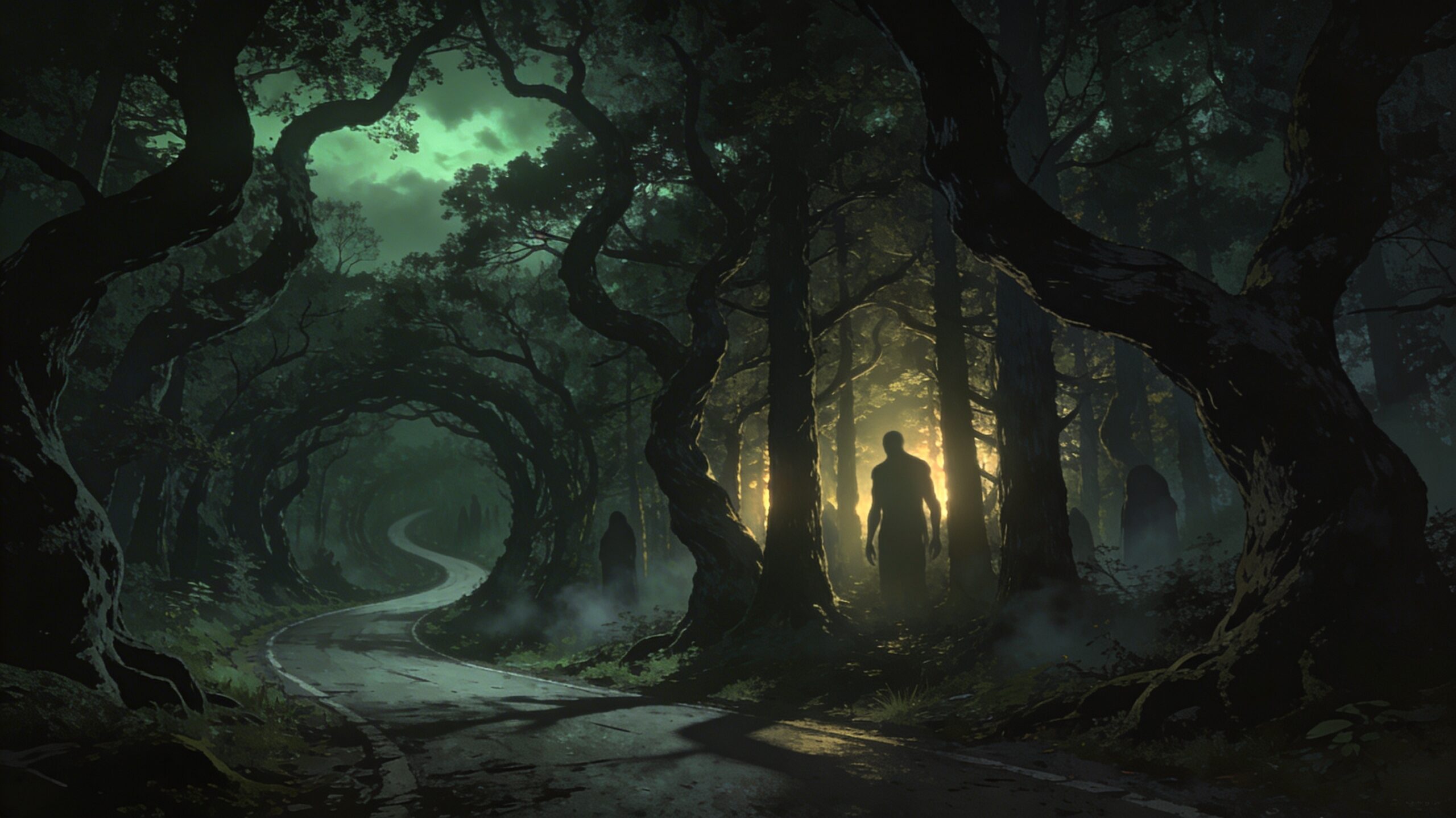
By the end of the season it’s clear the forest is not just scenery – it is an active enemy. It shifts roads, bends space, and constantly throws people back toward the town when they try to leave. Every attempt to escape through the woods ends in loops, disorientation, or a new kind of horror. The forest behaves like a closed system: it lets you in, but it doesn’t let you out, and it seems to “learn” from the characters’ behavior.
In that sense, the forest feels like a living organism or a controlled environment. It adjusts the rules as the characters get closer to the truth, keeping them trapped in a cycle of fear and hope.
The monsters from the forest – metaphor or real evil?
The creatures that come from the forest look like a mix of vampires, demons, and perfectly adapted predators. At night they appear almost human, talk to people, and weaponize emotions by taking the shape or voice of loved ones. During the day they vanish, bound to darkness and to the woods themselves. Their ability to mimic voices and memories suggests a direct connection to the characters’ minds.
This opens two major interpretations:
- the monsters are extensions of a larger entity that controls the forest, or
- the forest itself is a conscious entity using “avatars” to hunt and torment people.
Either way, the message is the same – the forest knows what scares you most and uses it against you.
The “game” with no clear rules
Another mystery is why people from completely different places suddenly end up on the same stretch of road that leads into town. The road always looks ordinary, until it bends into the same forest and funnels them to the same place. This feels like a deliberate mechanism: something is pulling people out of their lives and dropping them into a maze with fixed rules – don’t open your door at night, stay behind talismans, follow the rituals.
In this “game,” the forest is both the entrance and the outer wall. It is the filter new people pass through and the barrier that prevents anyone from leaving. That makes the entire world of From feel less like an accident and more like a constructed system or punishment.
Boyd’s journey into the heart of the forest
When Boyd decides to go deeper into the woods than anyone else, the show suddenly shifts from physical survival horror into psychological and almost spiritual horror. The deeper he goes, the more the forest attacks him with visions, voices, and scenes pulled from his worst memories and guilt. Reality blurs: we’re never fully sure where the line is between hallucination and truth.
His journey strongly suggests the forest is layered – it’s not just trees and monsters, but a threshold between the surface world of the town and something “behind the curtain.” Boyd doesn’t just face danger; he faces customized torment. The forest uses his personal history as a weapon, trying to break him before he can uncover anything meaningful.
The forest as the “server” of the entire system
If the town is the user interface of this nightmare – the visible part where people live and die – then the forest is the backend, the hidden infrastructure where the real control lies. Deep in the woods we see strange structures, symbols, and anomalies that don’t fit any natural explanation. Time and space warp there more aggressively than anywhere else.
That’s why every serious attempt to understand the mystery has to go through the forest. It’s where:
- the monsters originate,
- the laws of physics break,
- and the strongest connection to whatever runs this world seems to exist.
Stepping into the forest is never just a physical risk; it’s a risk to sanity and identity.
So what does the ending in the forest actually mean?
The ending doesn’t give a clean answer like “it’s all a simulation” or “they’re in purgatory,” but it points strongly toward the idea of a controlled environment. The characters never truly break the cycle – every attempt to escape or decode the rules pulls them deeper into the woods and into more complex traps.
In that sense, the forest represents the core of From’s horror: it is the place where the boundary between external evil and internal demons disappears. The more the characters run toward the trees searching for a way out, the more they are forced to confront guilt, fear, and trauma – yet they remain stuck in the same closed loop. The ending suggests the forest is not meant to be “solved” quickly; it is designed to keep testing them.
How it connects to other “twisted” endings
If you enjoyed piecing together the forest mystery in From, you’ll probably like other endings that mix supernatural horror with psychological games. On the site you can already dive into another detailed breakdown of a mind‑bending finale in our article: